
Welding and machining are both essential processes in metal fabrication, but they serve very different purposes. Understanding the distinction helps you make smarter decisions about how your custom parts get made and which processes your project actually requires.
At Metaltech, we offer both welding and CNC machining services under one roof. Here’s how these two fabrication methods differ and when each one comes into play.
The Basic Difference
The simplest way to think about it: welding adds or joins material, while machining removes it.
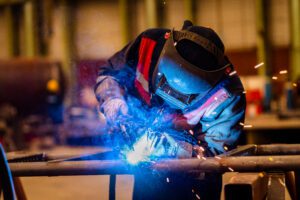
Welding uses heat, pressure, or both to fuse separate metal pieces into a single assembly. The process melts the base metals (and often a filler material) to create a permanent bond. Once cooled, the joint becomes as strong as or stronger than the original material.
Machining starts with a solid piece of metal and cuts away material to achieve the desired shape. Using tools like lathes, mills, and CNC equipment, machinists remove excess material with precision to create detailed features, tight tolerances, and smooth surface finishes.
When Welding Is the Right Choice
Welding excels at joining multiple components into larger assemblies. If your project involves attaching brackets, building frames, assembling enclosures, or connecting structural members, welding is typically the way to go.
At Metaltech, our welding capabilities include MIG welding for industrial-strength joints, TIG welding for specialty materials and aesthetic applications, and robotic welding for high-volume production requiring consistency and speed. We also use resistance spot welding to attach fasteners like nuts and studs for easier final assembly.
Welding is ideal when you need permanent joints that can handle significant stress, vibration, or load. It’s also the go-to method when watertight or airtight seals are required.
When Machining Is the Right Choice
Machining is all about precision and detail. If your part requires tight dimensional tolerances, complex geometries, threaded holes, or smooth surface finishes, machining delivers results that other processes can’t match.
Our CNC and manual machining services allow us to create intricate features and hold tolerances that welding alone cannot achieve. Machining is also essential for preparing parts before welding (such as beveling edges for weld penetration) or finishing parts after welding (such as facing surfaces or boring holes to final dimensions).
Machining works best when you’re shaping a single piece of material rather than joining multiple pieces together.
How Welding and Machining Work Together
In many custom fabrication projects, welding and machining complement each other. A typical workflow might look like this: raw materials are cut to size, individual components are machined to precise specifications, those components are welded into an assembly, and then final machining operations clean up weld areas or add features that require tight tolerances.
For example, a structural frame might be welded together from multiple pieces, then machined afterward to ensure mounting surfaces are flat and holes are perfectly aligned. This combination gives you both the structural integrity of welded joints and the precision of machined features.
Frequently Asked Questions
Can a part be both welded and machined?
Absolutely. Many assemblies require welding to join components and machining to achieve final dimensions or add precise features. At Metaltech, we handle both processes in-house, which streamlines production and ensures quality control throughout.
Which process is more expensive?
It depends on the part. Machining costs increase with complexity and tight tolerances. Welding costs depend on joint design, material thickness, and production volume. Often the most cost-effective approach combines both methods strategically.
Does welding affect dimensional accuracy?
Welding generates heat, which can cause distortion in some parts. Skilled welders and proper fixturing minimize this effect, and post-weld machining can restore precise dimensions where needed.
What materials can be welded vs. machined?
Most metals can be both welded and machined, though some require special techniques. Aluminum, steel, stainless steel, and titanium are all weldable and machinable. Our team can advise on the best approach for your specific material.
Get the Right Process for Your Project
Choosing between welding and machining (or determining how to combine them) depends on your part design, material, tolerances, and application. At Metaltech, we evaluate each project and recommend the fabrication methods that deliver the best results for your specific needs.
Have questions about your next project? Request a quote or call us at 417-426-5577 to talk with our team.